Summary Statement

Public-facing identity copy

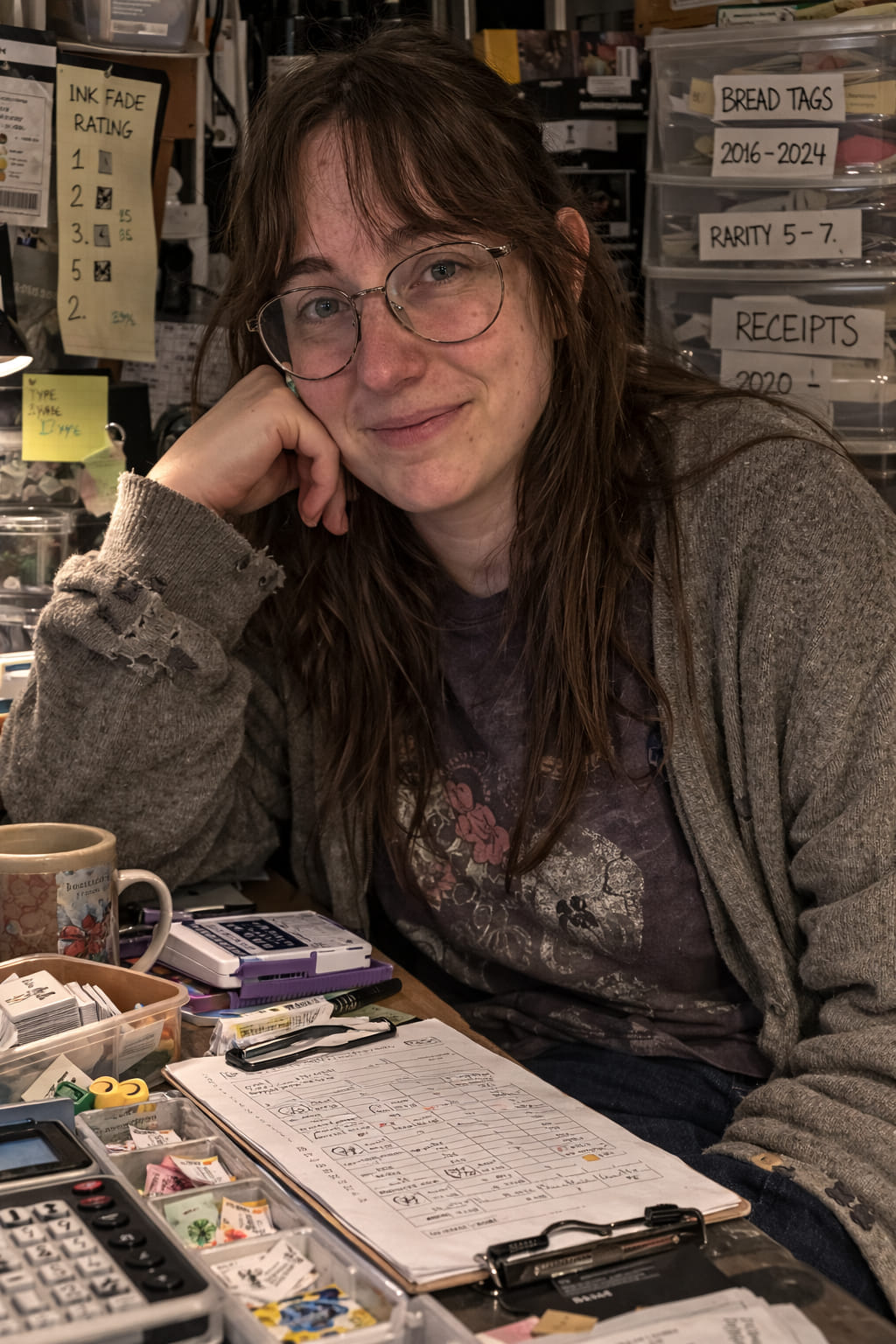
I am Marina Elowen Kessler. I work part-time in municipal records digitization and spend the remainder of my structured hours maintaining a domestic archive of small, usually discarded objects.

My central belief is that ordinary packaging and minor household remnants contain measurable evidence of manufacturing change, consumption patterns, and design decisions that most people never pause to document.

I do not describe this work as hoarding. My preferred term is Domestic Micro-Archivalism. The distinction matters because the system comes first. Every object must be sortable, describable, measurable, and physically placeable within the archive.

Human civilization produces millions of small artifacts daily. Most people discard them. I preserve the overlooked data of everyday life.
Tall portrait of Marina Elowen Kessler

Shoulder-length brown hair, usually tied in a low bun. Rectangular wireframe glasses. Neutral cardigans. Denim. Practical shoes. Object pouch usually present.

Psychological Drivers

Working explanation, self-reported

1. Completion Satisfaction

Marina reports feeling calm only when objects are placed inside a complete system. Unsorted items produce what she calls categorical discomfort.

2. Pattern Tracking

Everyday trash is treated as evidence. She believes small changes in cap ridging, plastic color, paper width, and logo typography reflect broader manufacturing shifts.

3. Fear of Losing Potential Data

She resists discarding objects because, in her terms, once an artifact disappears, its contextual meaning disappears with it.

Apartment as Archive Infrastructure

apartment layout

Living Room

The living room functions as a warehouse-facing public zone: five industrial metal shelving units, forty-two labeled archival boxes, and one small folding chair for guests.

Main categories: plastic artifacts, paper ephemera, packaging components.

Bedroom

The bed occupies roughly forty percent of the room. Remaining space is allocated to filing cabinets, labeled under-bed bins, and tools stored at immediate reach.

Nightstand contents: label maker, measuring calipers, magnifying glass.

Kitchen

Most cabinets store categorized packaging materials. Food storage is notably minimal when compared with preservation materials and intake overflow.

Example drawers: rubber bands by diameter, produce stickers, spare bread clips.

Daily Routine

Stable schedule pattern
7:10 AM

Morning Intake Review

Coffee first. Then a review of the object intake tray from the previous day. Items are cleaned, measured, assigned catalog numbers, logged into the spreadsheet, and filed physically.

Average processing time: 2.4 minutes per object.

Work Day

Field Acquisitions

During municipal digitization work, Marina often brings home discarded paper slips, office packaging, and broken pen caps. These are described as field acquisitions.

8:30–10:15 PM

Evening Cataloging Session

Formal cataloging window. Audio background is usually public radio or a long documentary about manufacturing, logistics, plastics, or historical production methods.

Collection Boundaries

Strict exclusions

Marina does not archive everything. The system depends on exclusion. Her rule is that collections must be dry, stable, and structurally categorizable.

  • Food waste
  • Biological materials
  • Liquids
  • Electronics

Archive Structure

How the archive is organized

Collections

Overview pages summarize totals, rarity, oldest examples, and classification systems for each major category.

Artifact Records

Individual objects are documented in a fixed order: identification, measurements, acquisition record, classification notes, observations, storage location.

Intake Logs

Short mechanical entries document daily or near-daily additions to the archive.

Methodologies

Technical pages explain catalog numbers, plastic tone indices, ink density scales, and filing systems.

Observational Notes

Short essays capture patterns discovered through accumulation. The tone remains analytical rather than confessional.

Publishing Rule

Nothing is published until three conditions are satisfied: catalog number assigned, measurements recorded, storage location documented.

Personal Note to Visitors

Visitors sometimes arrive expecting humor or novelty. What I offer instead is structure. The objects documented here are minor, but the systems required to keep them legible are not minor. If an archive is only built for obviously significant things, it fails to record the texture of ordinary life.

Most material culture disappears unnoticed. This site exists because I do not think disappearance should be the default outcome for every small object that passes briefly through a household.

The archive is not complete. It is only persistent.