Narrow Content Zones
The site uses sidebars, stacked panels, and central reading columns to make the pages feel like compact filing surfaces rather than wide contemporary layouts.
colophon / site notes / structural explanation
Notes on how this site is arranged, why it looks like this, and what kind of archive surface it is trying to be.
This site is designed as a complete public-facing personal archive for Marina Elowen Kessler: part domestic inventory system, part handmade web artifact, part shrine to overlooked household objects.
It is not meant to feel like a polished portfolio, a corporate brand surface, or a modern content platform. It is meant to feel inhabited, overarranged, slightly excessive, and specific to one person’s long-running classification habits.
The basic design problem was how to make an archive of bread tags, receipts, bottle caps, twist ties, and related domestic remnants feel emotionally legible without sacrificing the systems-minded voice of the persona. The answer was to let the site remain structured while giving the structure a dense, decorative shell.
The site uses sidebars, stacked panels, and central reading columns to make the pages feel like compact filing surfaces rather than wide contemporary layouts.
Borders, buttons, counters, badges, scanlines, icons, and little framed boxes are used to create the sensation of a personal archive that has been annotated over time rather than freshly launched.
Window headers, tab strips, status pills, and directory-style lists echo old interfaces and filing systems, which supports Marina’s clerical and classificatory identity.
The goal was never random chaos. The pages are cluttered, but the clutter is aligned to mood, hierarchy, and navigation needs.
The front door. Establishes Marina’s archive voice, major collections, and current research emphasis.
Two levels of identity. About is more human-facing. Dossier is more structured and record-like.
The visual and chronological cores. Gallery handles object atmosphere. Archive handles time order and intake logic.
The site’s interpretive layer. This is where repeated sorting becomes language.
Personal web furniture. These pages make the site feel lived in and connected outward.
Soft-focus chambers for attachment, favorite specimens, and the archive’s more private emotional weather.
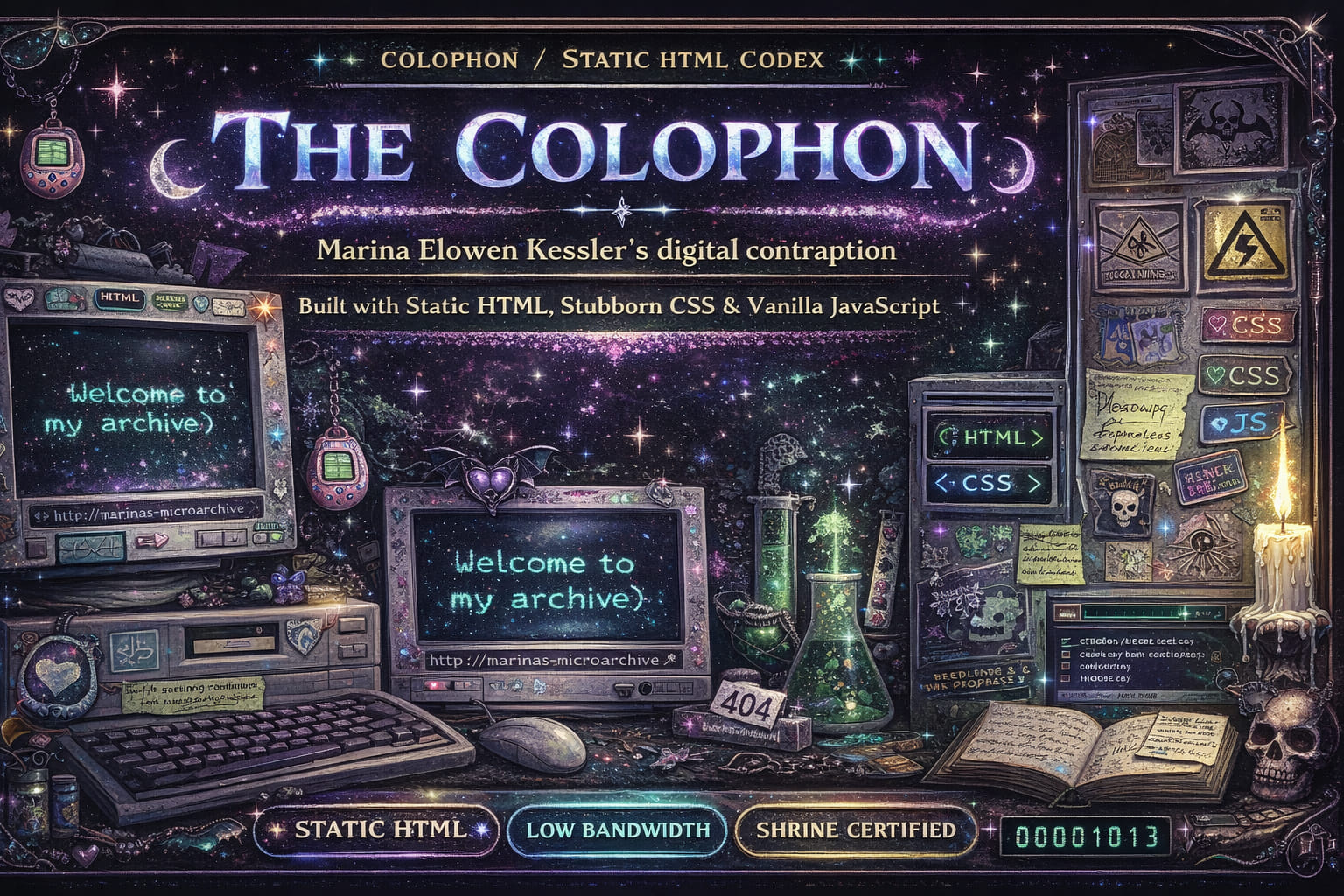
The site is built as a plain static website using HTML, CSS, vanilla JavaScript, and SVG assets. There are no frameworks, build tools, external databases, forms, audio systems, or server-side dependencies required for ordinary viewing.
Decorative badges, buttons, stamps, icons, dividers, frames, and sigils are handled with SVG so they can remain lightweight, editable, and consistent with the site’s old-web aesthetic without requiring separate image production.
JavaScript is kept small and period-appropriate: tab behavior, faux counters, theme switching, blink controls, window-style dragging, and gallery viewing. The site remains primarily document-based rather than app-like.
Everything is intended to be portable and hostable on ordinary static hosting, including Neocities-style environments.
The content tries to stay faithful to Marina’s classificatory temperament: precise, dry, observant, emotionally restrained, but not empty.
Rather than overt confession, attachment appears through extra precision, favorite subgroups, special specimen pages, and quietly reverent phrasing.
The site is designed so the world feels internally complete: categories recur, box logic returns, motifs repeat, and even the decorative extras are aligned to the archive’s systems.
The site deliberately preserves old-web density, sidebars, button clusters, shrine modules, and “too much page” energy because that makes it feel personal instead of generic.
A site like this should admit how it was made. The archive is about labels, categories, and retrieval. A colophon is simply that same impulse turned back toward the site itself.
The point is not to flatten the mystery out of the pages. The point is to let the structure show through the ornament for a moment.